
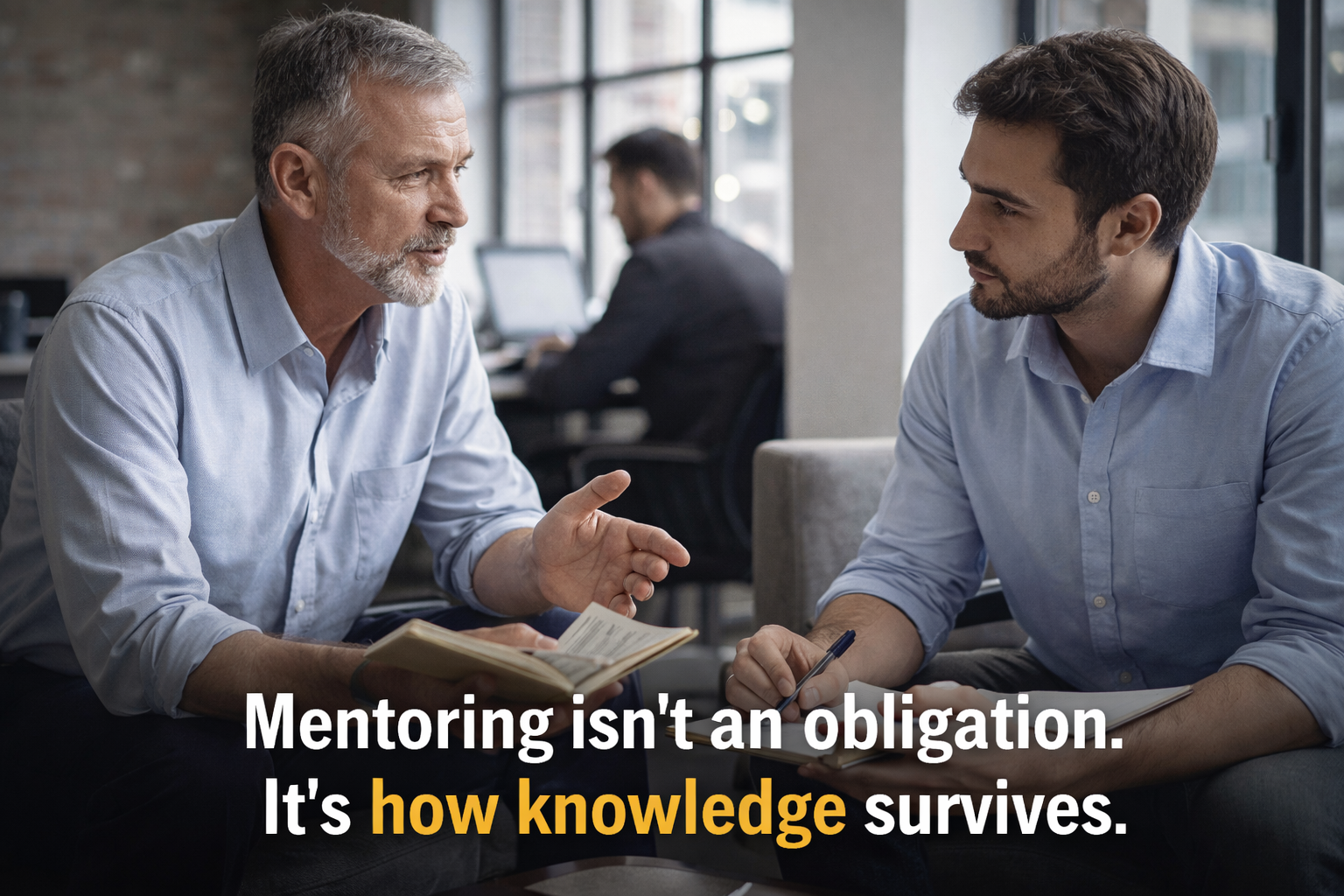
At some point in every career, the question becomes unavoidable: am I here just to execute, or am I responsible for passing something on?
Mentorship is often packaged as a noble duty or a shiny leadership merit badge. That framing misses the point. The actual “why” is less polished and far more practical.
Mentoring is a privilege. Being asked for guidance means someone believes your experience matters. It means your mistakes turned into something worth sharing. That trust isn’t just given, it’s earned through credibility, empathy, and time in the trenches. Look at it this way, mentoring isn’t about authority or titles. It’s really about stewardship. You’re holding knowledge that deserves to be shared, and it’s your responsibility to pass it along. I learned this the hard way, watching good people retire and take decades of wisdom with them.
That being said, mentoring can feel like an obligation. One more demand on an already overloaded calendar. Meetings stack up. Fires burn. Deadlines don’t care about personal growth. In those moments, mentoring feels inefficient. Why spend an hour helping someone think through a problem when you could solve it yourself in ten minutes and move on?
This is where a lot of capable professionals politely opt out.
The irony is that mentoring feels most inconvenient precisely when it matters most. Just starting career professionals don’t yet know what to ask. Mid-career leaders are buried in responsibility but uniquely qualified to translate theory into reality. Senior leaders have perspective but are furthest from the daily grind. Every stage comes with a perfectly logical excuse to say, “Not now.” And that’s exactly how institutional memory disappears.
A friend of mine once pointed out how badly organizations fail at passing down Tribal Knowledge. How decades of hard learned lessons are lost simply because no one slowed down long enough to share them. Mentoring doesn’t live in formal programs; it happens in real conversations. In frustration, in humor, in the occasional uncomfortable truth delivered with good intent, growth takes place.
Mentoring isn’t a detour from your career. If it is done right, it can actually sharpen your career. Because teaching forces you to explain with clarity, if you can’t explain it in a way for someone to understand, do you really understand? Mentoring only works when both sides are committed. The mentor to guide and challenge, and the mentee to show up ready to learn.
Careers are built on individual effort. Legacies are built on shared growth. Mentoring isn’t an obligation. It’s a choice, and it says a lot about how you yourself define leadership.