
Tracing my family tree stirred up something I didn’t expect. It wasn’t curiosity or nostalgia. It felt more like a steady nudge toward a place I had never lived, never visited, and yet somehow already knew.
It was a pull toward “home,” even though I had never been there.
For most of my life, the Upper Hoosic Valley existed only as a collection of towns, names, dates, and scanned records on a computer screen. In reality, it was never defined by one town or even one state. For more than two hundred years, my family lived along the New York–Vermont line, where borders mattered on maps but rarely in real life. Over generations, that line blurred as people married, moved, worked, and built lives on both sides.
It was the region Grandma Moses lived for most of her 101 years. It’s where my grandfather grew up before leaving as a young man, returning only for weddings and funerals. The unavoidable bookends of life that bring people back, whether they want to go or not.
It is also where Tuffield Barber settled after crossing into the United States from La Prairie, Canada in the early 1800s. Born in 1804, he carried our name into this country with a single decision, planting roots in a place where state lines mattered less than family and hard work. He could not have imagined what that choice would mean two centuries later, or that someone carrying his name would still be walking around with it printed on a driver’s license.
Eventually, curiosity turned into intention, and my wife, my oldest son, his wife and I decided to go. Two generations heading north to meet several more we had only ever known through documents and databases.
We stayed in a house built in the mid-1800s. Most of the home retained its colonial character, while the kitchen had cathedral ceilings, skylights, and modern conveniences that fit surprisingly well.
The real show stopper was when you stepped outside onto the deck. The house sat beside a fast moving stream that spilled over rocky falls in the backyard like it had been doing faithfully for hundreds of years. We sat there watching, mesmerized, as the water moved forward, unconcerned with who was watching. Ducks swam, birds fished, nature kept on living.
Each morning, I stood there with a cup of coffee and let it soak in. The trees, the air, the water. It was impossible not to feel connected. There is something grounding about realizing that while your life feels urgent and complicated, history keeps flowing at its own pace, indifferent to your timetable and your worries.
My daughter-in-law was with us on the trip, and when she realized we were in the area where Robert Frost had lived, her excitement was immediate and genuine. It took about thirty seconds to decide we had an added stop. That is one of the best things about traveling with people who care about different things than you do. They open doors you would have walked right past.
I knew Frost’s poems the way most people do, from school, from greeting cards, from the few lines that have worked their way into the culture. What I did not know was how central apple trees were to his life and his work. He planted them, tended them, and wrote about them. They were not just scenery. They were part of how he saw the world.
Walking the property, seeing the apple trees, it became clear. The older trees were gnarled and wide, standing unprotected in the open, shaped by decades of hard winters into something that looked permanent. Beside them, young saplings grown from grafts of the original wood were ringed by wire cages, simple protection against the careless pass of a lawnmower or a string trimmer. The kind of small, accidental damage that can end something before it ever has a chance.
I stood there longer than I expected to. There was something about that moment I wasn’t ready to walk away from. We spend so much time talking about what we inherit, the strength, the resilience, our roots. But the young trees reminded me that new growth needs protecting too. You can be grafted from something great and still not survive if the wrong thing catches you too early.
One of the things I looked forward to most was finally meeting two cousins more than twenty years older than I am. Until then, they had simply been names attached to census records, photographs, and family trees. One of them had spent years researching both our family and her husband’s, preserving stories and connections that otherwise might have disappeared.
Before the trip, one genealogy website listed one of my cousins as deceased. After spending the day with him, I was happy to correct the record. He looked remarkably healthy for a dead man.
Later, as we walked through the cemeteries together, my other cousin didn’t see rows of headstones the way I did. She saw family. She would point to one marker, tell us who was buried there, then gesture toward another and explain how the families were connected or tell a story of shared history. It was less like visiting a cemetery and more like walking through a hometown with someone who knew every family that had ever lived there.
We visited Rosewood Cemetery in White Creek, NY, where row after row of familiar names told the story. More than forty family members rested there, including my great grandparents, my great great grandparents and my great, great, great grandparents. The earliest family markers from the 1880s and the most recent from the late 1990s. They represented generations of Barbers who lived ordinary lives, worked honest jobs, raised families, paid their bills, solved the problems in front of them, and handed the baton forward without ever knowing who would eventually receive it.
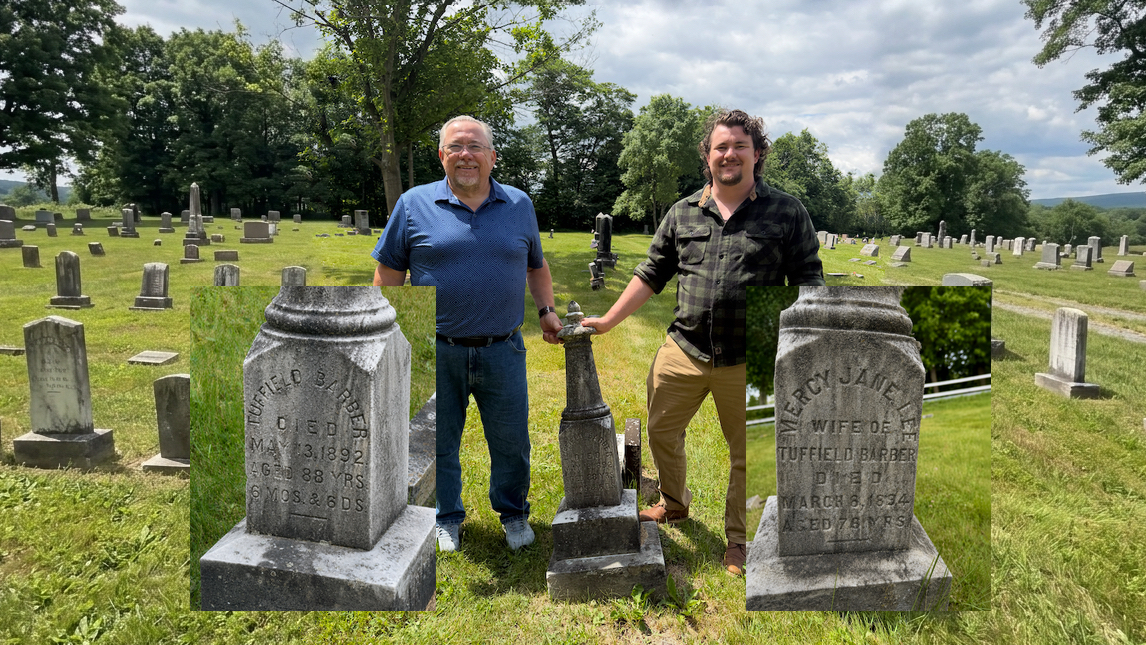
My son and I took a picture with the tilted spire of Tuffield and his wife, Mercy Jane Lee. Standing there, it became clear that this trip was not about learning more about the past, but about understanding my place in the line.
None of those people knew me. None of them knew what the world would look like when I arrived in it. They did what they were supposed to do in their time and trusted that someone down the road would do the same.
And somewhere along the way, I realized that someone is me.
That realization carries weight, not the kind that feels like pressure, but the kind that feels like responsibility. The kind that reminds you that your choices echo longer than you think, that the way you show up today becomes part of someone else’s story tomorrow.
Not long before the trip, I discovered a small piece of family legacy sitting in plain sight, right in front of me.
While sorting through some family things, I came across a book published in 1851 titled LADIES WREATH that must have belonged to my great grandmother, Maude Sawyer Barber. She was born in 1882, and I suspect the book was given to her as a young woman, although the book itself was already decades old by then. It has a red leather cover with an ornate circular gold floral wreath pressed into the front. Inside the cover was her maiden name, Maude Sawyer, elegantly written in the center of the page.
Deeper in the book, I found a page carefully handwritten, listing the names of all of her children along with their birthdates.
Before formal birth certificates were common, families often recorded life’s most important moments in the blank pages of a Bible or a treasured book. Births, marriages, deaths, and children’s names were written down so the next generation would remember.
At the time, it felt like a remarkable family artifact. After standing in that cemetery in the Upper Hoosic Valley, it felt like something more. It was another link in the same chain, someone taking the time to record the next generation so the story would not be lost.
So now, when I think about the New York–Vermont borderlands, I do not think about it as a place I visited once. I think about it as a reminder to live life in a way that makes it easier for whoever comes next. A reminder that one day my name will be on a stone somewhere, and what will matter most is not what I accumulated, but what I passed on.