
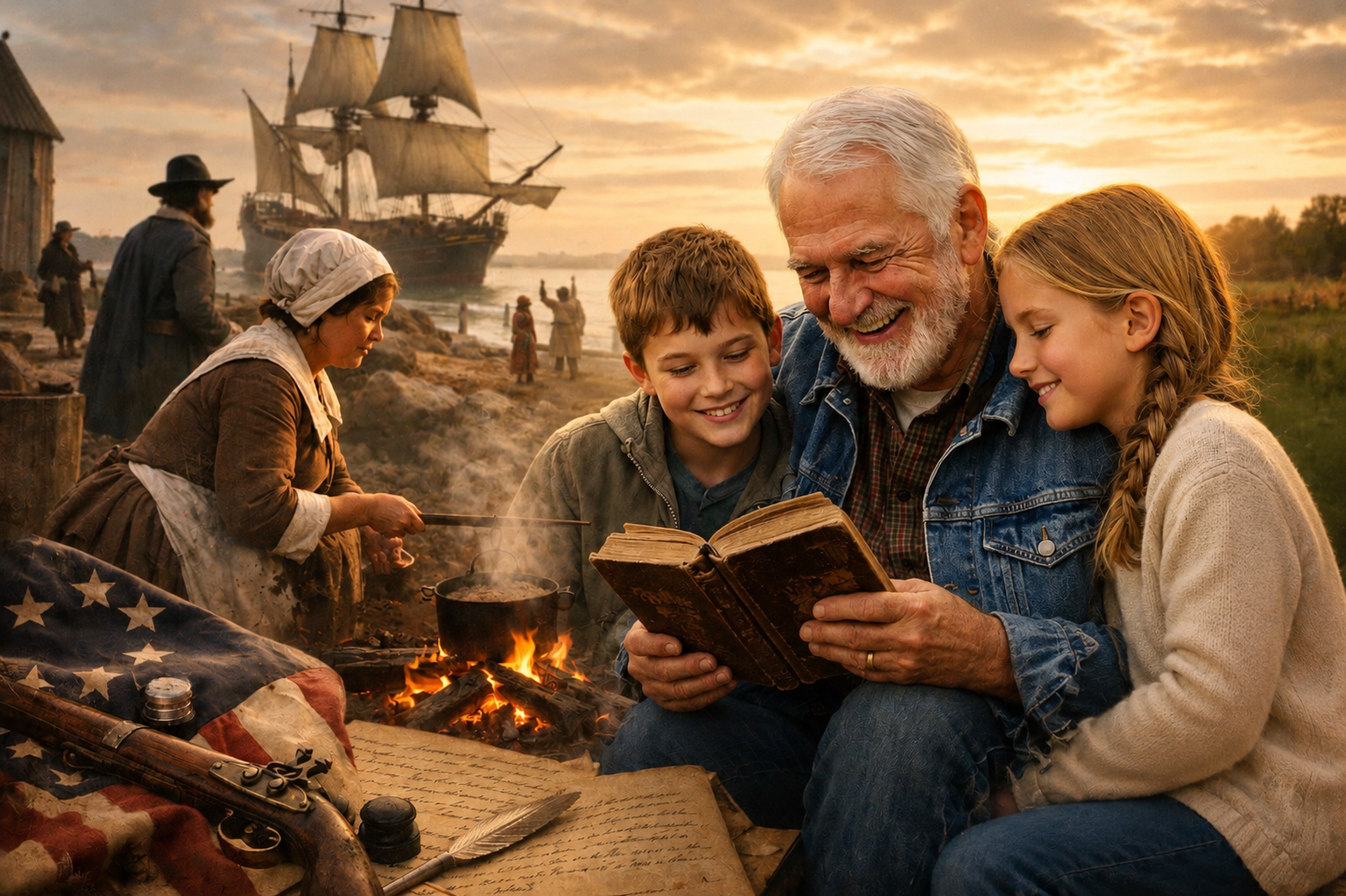
I started digging into my family tree for a pretty simple reason: my grandchildren. Something changes when you hold a new generation in your arms. You stop thinking only about what’s ahead and start wondering about what’s behind you, too.
You begin thinking about what kind of line they’re stepping into, the shoulders they’re standing on, and whether you’ve done your part to leave something solid for them to build on.
I had always been curious about where we came from. I just never had enough motivation to do anything about it. Life was constant motion, work was hectic, raising kids was chaos, and curiosity kept getting pushed down the list of priorities until one day it didn’t anymore.
What I found wasn’t glamorous, and it certainly wasn’t something out of a movie. There were no castles, no royalty, and no dramatic scandals buried in dusty records.
What I found were mostly farmers in New England, boat captains, and working people who knew tides, seasons, and responsibility better than they knew comfort. They were men who understood hard work and women who knew how to stretch whatever they had. They didn’t make history books, but they quietly kept the country running.
I also learned something that genuinely surprised me. Most of my heritage is English, not Irish like the family legend always claimed. It turns out family stories tend to age a little like fishing stories. They usually get better with time, even when the facts don’t quite cooperate.
The Barber name itself came through a man named Tuffield Barber, who was born in 1804 in LaPrairie, Canada, just across the Saint Lawrence River from Montreal. The family name was most likely Barbeau dit La Riviere before it was shortened to Barber after arriving in America. Can you imagine trying to spell that one in kindergarten?
Tuffield was a fur trapper who eventually crossed into the United States and brought the shortened name with him, along with whatever grit it took to leave one life behind and start another.
That alone would have been interesting enough. What really made me pause was what I found about military service. I discovered great-grandfathers and great-uncles who fought in every major American conflict, including the Revolutionary War, the Civil War, and everything that followed. Generation after generation, when the country called, someone in my line answered, packed up, and went.
I traced eleven great-grandfathers who served in the Revolutionary War. That brought back a memory I hadn’t thought about in years. I remembered the Bicentennial in 1976, with red, white, and blue everywhere, tall ships in the harbor, parades in the streets, shiny bicentennial quarters that I still pocket and save to this day, and fireworks lighting up the sky.
Even as a kid, I remember thinking how incredible it must be to have ancestors who were actually there when America was born, who stood up to a king, told him what to do with his taxes, and meant it. It turns out I do.
Almost by accident, I clicked a button on one of the genealogy sites that showed my nationality breakdown, and it said I was 32 percent American. That didn’t make much sense to me at first, because in school we were taught that everyone came from somewhere else and that there were no “real” Americans, just immigrants.
So I started digging into that, too. Apparently, if your family has been in one place for six to eight generations, it is considered native to that land. That sent me even further back than I ever expected to go, because once you start asking those questions, it becomes hard to stop. How far back could I trace it? Who was the first one here in my line?
That search led me to my twelfth great-grandparents, William Brewster and his wife, Mary, who arrived in 1620 on the Mayflower. Mary Brewster was one of only four adult women who survived both the voyage and the first brutal winter.
She was part of the small group who prepared the first Thanksgiving meal in 1621, standing over a fire in a settlement surrounded by uncertainty, helping create a moment of gratitude in a world that barely resembled anything we know today.
I was born on Thanksgiving Day. It has always been my favorite holiday, not because of my birthday, but because of what it represents: family, gathering, gratitude, and people choosing, at least for one day, to remember what matters most. I didn’t know any of this growing up, and I didn’t need to. But knowing it now feels different.
America turns 250 this year, and my family has been here for all of it. Not as famous names, not as powerful people, and not as headline makers, but as steady ones. Farmers, sailors, soldiers, mothers, fathers, and builders who showed up and did the work in front of them.
Now, when I look at my grandchildren, I realize they are not just inheriting my stories. They are inheriting all of theirs: four hundred years of work, sacrifice, faith, and stubborn hope. That is as humbling as it is motivating. Because in the end, the question is not where we came from, but what kind of chapter we will write next.