
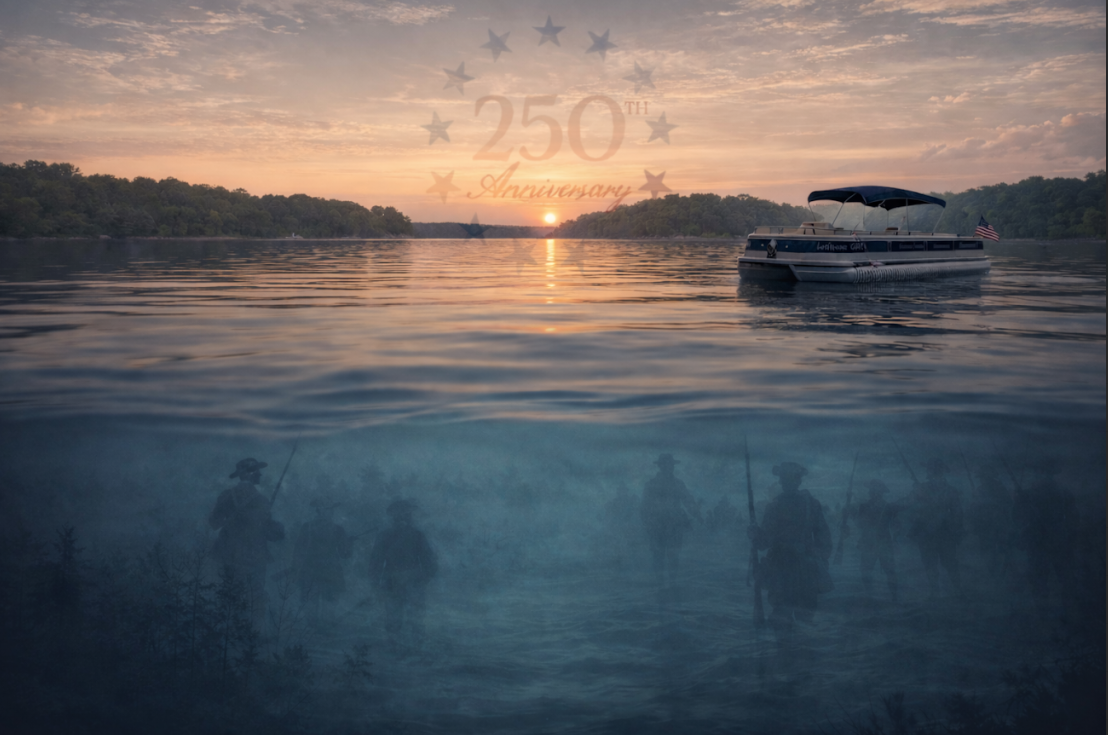
If you have spent any time on Lake Norman, you know the vibe. It’s a landscape of $150,000 wake boats and massive glitter boat mafia rigs. The coves can get so crowded you can practically walk across the sun decks to get to shore. On any Saturday in July, the lake is an exhibition of modern excess.
You might never realize the sharp contrast. All this new money energy sits on water that covers one of the bloodiest stretches of early American frontier. As the 250th anniversary approaches, that history is starting to come back into focus.
Before Duke Power flooded the valley in the 1960s to create the lake, this was not the playground we have today. The land was a hard stretch of frontier country where the American Revolution played out in ways that rarely make it into textbooks. The towns we talk about now, Huntersville, Cornelius, and Davidson, were barely settlements in the 1770s. The Revolution was not a clean, organized war with polished uniforms and marching bands. Neighbors didn’t always agree on what freedom meant, and the Revolution often blurred the line of what they were fighting for.
Researching my family story, the Revolution stopped being something I read about in textbooks and became lines I could trace through my own family tree. I found my 6th great-grandfather, Judah Chandler. In 1775, he was right there at the capture of the British schooner Margaretta off Machias, Maine, one of the very first naval conflicts of the Revolution. That moment wasn’t polished or ceremonial. It was ordinary men like Judah deciding they had reached the point where enough was enough.
Finding that connection changed how I looked at everything. It made me realize that the same breaking point Judah reached in the Northeast was being reached right here along the rivers of North Carolina. The west side of the lake carries its own Revolutionary past. The area around present day Denver was already settled during the Revolution, and many of the farmers there served in the Lincoln County militia. Several officers and captains in that regiment came from communities along the Catawba River that are now part of eastern Lincoln County.
If you want to feel that history for yourself, the best thing you can do is step away from the water for an afternoon. A short drive west takes you to Lincolnton and the hillside where the Battle of Ramsour’s Mill was fought.
Today it is quiet farmland, but in June of 1780 it was chaos. Local militia units made up of farmers, blacksmiths, and teenage boys collided there before sunrise. Many of the men fighting that morning lived just a few miles apart and knew each other. It was not some distant battlefield, but one where everyone knew someone on the other side.
Then there is Cowan’s Ford. Most people around the lake know the name because of the dam that holds Lake Norman back. Long before that dam existed, Cowan’s Ford was one of the main crossings on the Catawba River.
In February 1781, Patriot militia tried to stop British General Charles Cornwallis at that crossing as he pushed his army through the Carolina backcountry. During the fight, North Carolina militia leader General William Lee Davidson was killed, and Cornwallis eventually forced his troops across the river.
When the rising water flooded the Catawba River valley in 1963, the historic crossing disappeared beneath the lake. The ground where that battle took place now sits underwater near the dam.
Which means when you boat near the dam today, you are floating above a Revolutionary War battlefield.
So the next time you are out there at sunset and the wake finally dies down, turn off the engine for a minute. With the noise gone and the water settling, it becomes easier to picture what this place looked like long before the docks and lake houses arrived.
Lake Norman may be a relatively new lake, but the dirt at the bottom has been part of the American story for a very long time.